


Page 16 - Top Cover Issue 15
P. 16
16   TOP COVER   MAY 2019


         way. Plus, they had a concrete goal, and
         this goal had real value to the group
         as a whole – it was not just a teaching
         exercise, however interesting, chosen by
         the trainer essentially for the benefit of
         the trainer. There was material benefit
         to them, rather than just theory, and
         they recognised this.
           Perhaps most importantly, the group
         as a whole had control of what was
         going on. They were aware of this
         fact and aware they could go beyond
         what they had been taught. They only                                                                       Picture copyright: Stuart Bolton / Shutterstock
         needed to refer to the trainers on
         those rare occasions where their own
         expertise was insufficient. There was
         no teaching ‘to suck eggs’, and a real
         start was made on planning a complex
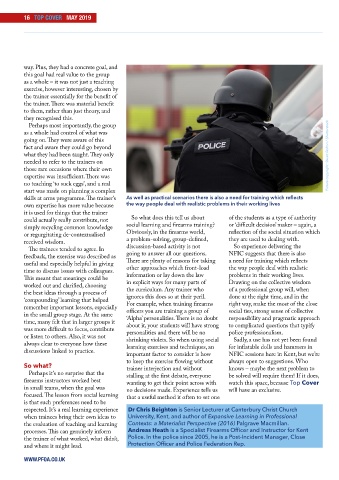
         skills at arms programme. The trainer’s   As well as practical scenarios there is also a need for training which reflects
         own expertise has more value because   the way people deal with realistic problems in their working lives
         it is used for things that the trainer
                                               So what does this tell us about   of the students as a type of authority
         could actually really contribute, not
                                             social learning and firearms training?   or ‘difficult decision’ maker – again, a
         simply recycling common knowledge
                                             Obviously, in the firearms world,   reflection of the social situation which
         or regurgitating de-contextualised
                                             a problem-solving, group-defined,   they are used to dealing with.
         received wisdom.
                                             discussion-based activity is not      So experience delivering the
           The trainees tended to agree. In
                                             going to answer all our questions.   NFIC suggests that there is also
         feedback, the exercise was described as
                                             There are plenty of reasons for taking   a need for training which reflects
         useful and especially helpful in giving
                                             other approaches which front-load   the way people deal with realistic
         time to discuss issues with colleagues.
                                             information or lay down the law     problems in their working lives.
         This meant that meanings could be
                                             in explicit ways for many parts of   Drawing on the collective wisdom
         worked out and clarified, choosing
                                             the curriculum. Any trainer who     of a professional group will, when
         the best ideas through a process of
                                             ignores this does so at their peril.   done at the right time, and in the
         ‘compounding’ learning that helped
                                             For example, when training firearms   right way, make the most of the close
         remember important lessons, especially
                                             officers you are training a group of   social ties, strong sense of collective
         in the small group stage. At the same
                                             ‘Alpha’ personalities. There is no doubt   responsibility and pragmatic approach
         time, many felt that in larger groups it
                                             about it, your students will have strong   to complicated questions that typify
         was more difficult to focus, contribute
                                             personalities and there will be no   police professionalism.
         or listen to others. Also, it was not
                                             shrinking violets. So when using social   Sadly, a use has not yet been found
         always clear to everyone how these
                                             learning exercises and techniques, an   for inflatable dolls and hammers in
         discussions linked to practice.
                                             important factor to consider is how   NFIC sessions here in Kent, but we’re
                                             to keep the exercise flowing without   always open to suggestions. Who
         So what?
                                             trainer interjection and without    knows – maybe the next problem to
           Perhaps it’s no surprise that the
                                             stalling at the first debate, everyone   be solved will require them! If it does,
         firearms instructors worked best
                                             wanting to get their point across with   watch this space, because Top Cover
         in small teams, when the goal was
                                             no decisions made. Experience tells us   will have an exclusive.
         focused. The lesson from social learning
                                             that a useful method it often to set one
         is that such preferences need to be
         respected. It’s a real learning experience   Dr Chris Beighton is Senior Lecturer at Canterbury Christ Church
         when trainees bring their own ideas to   University, Kent, and author of Expansive Learning in Professional
         the evaluation of teaching and learning   Contexts: a Materialist Perspective (2016) Palgrave Macmillan.
         processes. This can genuinely inform   Andreas Heath is a Specialist Firearms Officer and Instructor for Kent
                                              Police. In the police since 2005, he is a Post-Incident Manager, Close
         the trainer of what worked, what didn’t,
                                              Protection Officer and Police Federation Rep.
         and where it might lead.
          WWW.PFOA.CO.UK

