


Page 15 - Top Cover Issue 15
P. 15
MAY 2019   TOP COVER   15


 BLOW-UP DOLLS AND A HAMMER


 Is there a place for social learning on the National  Firearms Instructors Course?  By Chris Beighton
                                                                      & Andreas Heath


      Image copyright: Albert Bandura, Stanford University / greatexperimnetblog.blogspot.com
                                                                              experience, so the programme has to
                                                                              take them from ‘zero to hero’ in a week.
                                                                                The role of the NFIC is to help
                                                                              trainers develop the skills and
                                                                              confidence to meet challenges like
                                                                              this, and here’s an example from a
                                                                              recent programme. Trainees had
                                                                              just completed a round-up exercise
                                                                              which refreshed their memories
                                                                              about some of the learning theories
                                                                              they had studied two days previously.
                                                                              Importantly, the exercise also contained
                                                                              some new information about how to
                                                                              do things. This new information was
                                                                              discovered by the trainees in the course
                                                                              of the activity; in essence, they had
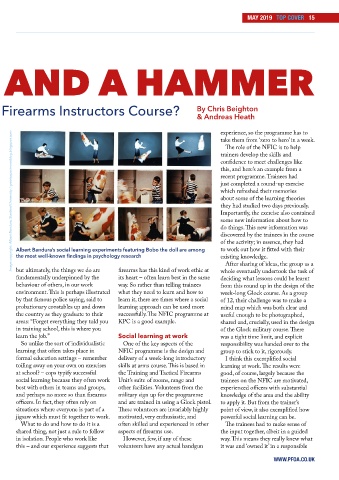
       Albert Bandura’s social learning experiments featuring Bobo the doll are among   to work out how it fitted with their
       the most well-known findings in psychology research                    existing knowledge.
                                                                                After sharing of ideas, the group as a
       but ultimately, the things we do are   firearms has this kind of work ethic at   whole eventually undertook the task of
       fundamentally underpinned by the    its heart – often learn best in the same   deciding what lessons could be learnt
       behaviour of others, in our work    way. So rather than telling trainees   from this round up in the design of the
       environment. This is perhaps illustrated   what they need to learn and how to   week-long Glock course. As a group
       by that famous police saying, said to   learn it, there are times where a social   of 12, their challenge was to make a
       probationary constables up and down   learning approach can be used more   mind map which was both clear and
       the country as they graduate to their   successfully. The NFIC programme at   useful enough to be photographed,
       areas: “Forget everything they told you   KPC is a good example.       shared and, crucially, used in the design
       in training school, this is where you                                  of the Glock military course. There
       learn the job.”                     Social learning at work            was a tight time limit, and explicit
        So unlike the sort of individualistic   One of the key aspects of the   responsibility was handed over to the
       learning that often takes place in   NFIC programme is the design and   group to stick to it, rigorously.
       formal education settings – remember   delivery of a week-long introductory   I think this exemplified social
       toiling away on your own on exercises   skills at arms course. This is based in   learning at work. The results were
       at school? – cops typify successful   the Training and Tactical Firearms   good, of course, largely because the
       social learning because they often work   Unit’s suite of rooms, range and   trainees on the NFIC are motivated,
       best with others in teams and groups,   other facilities. Volunteers from the   experienced officers with substantial
       and perhaps no more so than firearms   military sign up for the programme   knowledge of the area and the ability
       officers. In fact, they often rely on   and are trained in using a Glock pistol.   to apply it. But from the trainer’s
       situations where everyone is part of a   These volunteers are invariably highly   point of view, it also exemplified how
       jigsaw which must fit together to work.  motivated, very enthusiastic, and   powerful social learning can be.
        What to do and how to do it is a   often skilled and experienced in other   The trainees had to make sense of
       shared thing, not just a rule to follow   aspects of firearms use.     the input together, albeit in a guided
       in isolation. People who work like   However, few, if any of these     way. This means they really knew what
       this – and our experience suggests that   volunteers have any actual handgun   it was and ‘owned it’ in a responsible

                                                                                                 WWW.PFOA.CO.UK

