


Page 8 - Top Cover Issue 6
P. 8
8  TOP COVER ISSUE 6


             A point worth considering with regards to video evidence is     Video footage portraying this angle was leaked to the media,
          to look at the effect that imagery has on potential investigators  the footage provided no support for the officer’s claims that
          and jurors. Early research work, previously undertaken in the  Hudspeth had turned and pointed a gun directly at them, thus
          US, has examined how members of a jury retain details in their  prompting the shooting.
          memory from different forms of evidence when summing up and      The  media  portrayed  Hudspeth’s  death  as  a  cold-blooded
          reaching a verdict:                                     execution, and reported upon the protest that followed: -
             One American study showed that the average juror retains 87%  ‘With a shuddering voice and teary eyes, a woman introduced as the
          of information presented visually, but only 10% of information  mother of Marquise Hudspeth thanked a crowd of several hundred
          presented orally.                                       people on the Milam Street steps of the Caddo Parish Courthouse on
            A further American survey showed that members of a jury retain  Saturday for keeping the memory of her son alive.
          twice the amount of information when viewing a visual presentation,  “He was my oldest son. He was an extension of my right arm,” she
          as distinct to an oral presentation.                    said. “I used to tell him his life would be harder than mine as a black
             It does seem likely therefore, that video evidence will remain  woman. I told him that he was a black male and no one was going
          more prominent in the minds of jurors despite any advice or  to give him anything.”
          warning from a judge on the biasing and framing effect of film.     Even as racial tensions simmered over the shooting, leaders at
             The  fatal  shooting  of  Marquise  Hudspeth  (USA,  2003)  really  Saturday’s march spoke of peace, religion, patriotism and justice.
          highlights the limitations and potentially biasing nature of video.  Signs that read “one people, one voice” and “we bind the spirit of
          Hudspeth had been chased by police and finally decamped from  racism, fear, murder and hatred.”
          his vehicle as police arrived behind him. Three cameras inside
          separate patrol vehicles captured the shooting.         Some marchers chanted “No Justice, No Peace.”


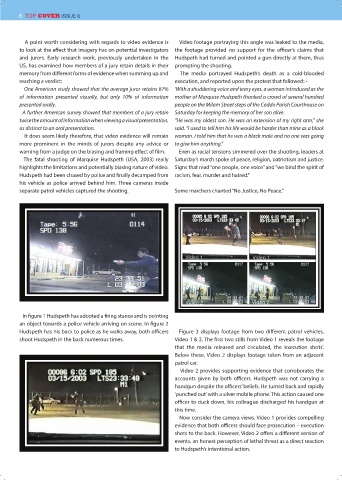
             In figure 1 Hudspeth has adopted a firing stance and is pointing
          an object towards a police vehicle arriving on scene. In figure 2
          Hudspeth has his back to police as he walks away, both officers    Figure 3 displays footage from two different patrol vehicles,
          shoot Hudspeth in the back numerous times.              Video 1 & 2. The first two stills from Video 1 reveals the footage
                                                                  that the media released and circulated, the ‘execution shots’.
                                                                  Below these, Video 2 displays footage taken from an adjacent
                                                                  patrol car.
                                                                     Video 2 provides supporting evidence that corroborates the
                                                                  accounts given by both officers. Hudspeth was not carrying a
                                                                  handgun despite the officers’ beliefs. He turned back and rapidly
                                                                  ‘punched out’ with a silver mobile phone. This action caused one
                                                                  officer to duck down, his colleague discharged his handgun at
                                                                  this time.
                                                                     Now consider the camera views. Video 1 provides compelling
                                                                  evidence that both officers should face prosecution – execution
                                                                  shots to the back. However, Video 2 offers a different version of
                                                                  events, an honest perception of lethal threat as a direct reaction
                                                                  to Hudspeth’s intentional action.

