


Page 8 - Top Cover Issue 4
P. 8
TOP COVER +557'


       Firearms attack on Police at Woolwich – a wounded subject lying   rapid reaction to a perceived visual threat.
       on the floor continuing to raise the handgun back towards ARV   T e dorsal stream provides the brain with rapid ‘danger’
       Officers, having – yes, survivable injuries.              information; this may often be a fast initial perception of
         T e difference between the two incidents will revolve around   movement. Movement captures visual attention, firing neurons
       visual confirmation – the definite confirmation of a handgun –   within the brain at a subconscious level. Specific threat cues may
       but what if the subject’s hands can’t be seen, only a movement   initiate the reflexive triggering of a ‘shoot’ response, especially
       that appears compelling and a specific threat – what then? Do    when the observed action ‘matches’ a contextually specific or
       you wait?                                               familiar cue. Pre-event information about the position of weapons
         Legally, proportionality can appear to be a straightforward   and subject intentions has a sensitising or framing effect; this
       and simple process. Many people genuinely believe they see every   assists the brain with anticipation and preparation for confronting
       detail of what occurs in front of them – however this is never   a subject.
       the case, we process very limited visual information as humans.   T e ability to initiate very fast anticipatory movements is
       Officers seldom have sufficient time to analyse exactly what is   an essential skill for ‘reading’ your opponent especially when
       happening and then deliver a judicially measured response – one   preparing and then commencing any physical interception. By
       that fits within such a well-constructed legal expectation. So how   way of a sporting illustration – subconscious and early visual
       precise is a process of continual assessment?           processing via the dorsal stream enables top tennis professionals
         Human decision-making is frequently imperfect as a process   to return serves of over 140mph.
       and this is especially true when individuals must operate under   With less than 0.3 seconds to visually observe and position
       a significant time pressure. Fine judgements and accurate   their own racket, tennis pros must scan and anticipate the arm
       perception can be fluid processes requiring varying degrees of   position of their opponent and the likely path of travel of the
       time for optimal analysis and response selection. T e human   tennis ball; this must all occur prior to the strike of the ball at
       visual system cannot always process information accurately and   service. To wait is to loose since the ventral stream lags behind
       keeping pace with the speed of a subject’s hand movements, body   – requiring additional information to determine what exactly is
       rotation or weapon position can be extremely difficult – often   happening. He who hesitates is lost!
       impossible in very short passages of time where vision is directed
       to a specific target.
         Procedural actions become stored within long-term memory
       after repeated practice and training. T reat cues receive privileged
       access within the brain via the amygdala, our emotional early
       warning system: a fast sub-conscious response mechanism to
       initiate fight or flight. T e purpose of motor skills training for
       firearms threats is to equip the individual with fast reactions for
       the skilled delivery of a tactical option and as a consequence,
       Officers become sensitised to specific threat cues that can be
       subconsciously triggered with very limited visual information.
       T e ‘gist’ of a movement is often enough to correctly anticipate
       what a movement means.
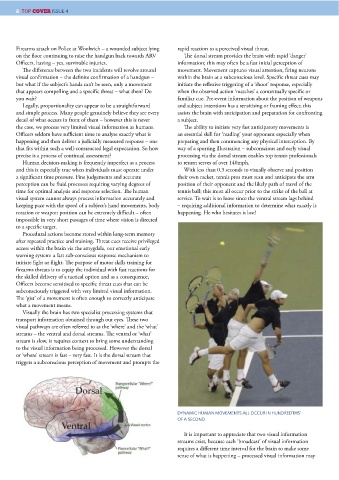
         Visually the brain has two specialist processing systems that
       transport information obtained through our eyes. T ese two
       visual pathways are often referred to as the ‘where’ and the ‘what’
       streams – the ventral and dorsal streams. T e ventral or ‘what’
       stream is slow, it requires context to bring some understanding
       to the visual information being processed. However the dorsal
       or ‘where’ stream is fast – very fast. It is the dorsal stream that
       triggers a subconscious perception of movement and prompts the


                                                               &;0#/+% *7/#0 /18'/'065 #.. 1%%74 +0 *70&4'&6*5²
                                                               1( # 5'%10&

                                                                  It is important to appreciate that two visual information
                                                               streams exist, because each ‘broadcast’ of visual information
                                                               requires a different time interval for the brain to make some
                                                               sense of what is happening – processed visual information may

