


Page 7 - Top Cover Issue 4
P. 7
TOP COVER +557'
A Scientific View 94+66'0 $; ' $.1%-5+&)'
Officer E7 had to make a split second decision in the face of discharge or a fleeting glimpse of a weapon as it rises towards
inadequate and imprecise information. T e context of decision- Officers? No. Expert biomechanical evidence has established
making is both dynamic and fluid, there may not be ‘just that a seated passenger inside a vehicle could raise and fire an
one’ correct interpretation for what is about to occur. Visual automatic pistol in 0.14 seconds.
information provokes conflicting individual choices; every Contextually, arm or hand movements may seem similar –
individual’s perception may be slightly different. However, when concealing drugs, undoing a seat belt or reaching for a handgun
dealing with a perceived lethal threat, a ‘tipping point’ is reached all have similar features. How then should any of us judge the
– a finite moment when a decision must be made based upon the intentions of a suspect suddenly rising from groping in the vehicle
emotions, feelings and expectations for what you honestly believe foot-well and then popping back up, when pre-event intelligence
is about to happen. T ereafter, every subsequent review and every highlights the potential for automatic weapons and a machine
precise consideration of a point of law, all flows with the benefit pistol threat?
that only hindsight can bring.
T is slow-time analytical review of evidence after a Police
shooting frequently becomes protracted, falling under the
demanding influences of social politics, media speculation
and organisational positioning. Eventually legal teams and
interested parties ‘test’ the perception of the Principal Officer
under some category of a cross-examination; the scenes played
out within the theatre of a judicial process. Decision-making,
context interpretation and the human capacity to process visual
information are seldom, if ever, considered at Inquest. Some may
think such matters unimportant, but to not consider such issues
is a failure of the inquisitional process.
In the case of Rodney his hands could not be seen – yet
weapons were next to him. T erefore the ability of E7 to respond
to any ‘rising’ firearm threat was dependent upon perceiving
and interpreting a specific ‘context’ for what a movement
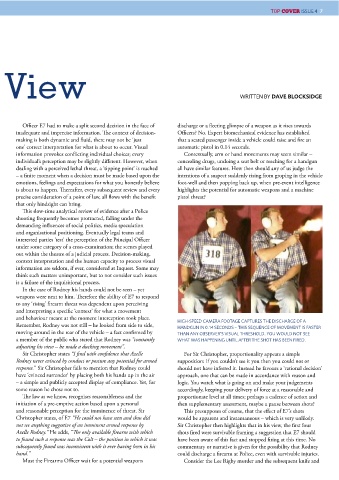
and behaviour meant at the moment interception took place. *+)* 52''& %#/'4# (116#)' %#2674'5 6*' &+5%*#4)' 1( #
Remember, Rodney was not still – he looked from side to side, *#0&)70 +0 5'%10&5 6*+5 5'37'0%' 1( /18'/'06 +5 (#56'4
moving around in the rear of the vehicle – a fact confirmed by 6*#0 #0; 1$5'48'4²5 8+57#. 6*4'5*1.& ;17 917.& 016 5''
a member of the public who stated that Rodney was “constantly 9*#6 9#5 *#22'0+0) 706+. #(6'4 6*' 5*16 *#5 $''0 (+4'&
adjusting his view – he made a ducking movement”.
Sir Christopher states “I find with confidence that Azelle For Sir Christopher, proportionality appears a simple
Rodney never evinced by conduct or posture any potential for armed supposition: if you couldn’t see it you then you could not or
response.” Sir Christopher fails to mention that Rodney could should not have inferred it. Instead he favours a ‘rational decision’
have ‘evinced surrender’ by placing both his hands up in the air approach, one that can be made in accordance with reason and
– a simple and publicly accepted display of compliance. Yet, for logic. You watch what is going on and make your judgements
some reason he chose not to. accordingly, keeping your delivery of force at a reasonable and
T e law as we know, recognises reasonableness and the proportionate level at all times; perhaps a cadence of action and
initiation of a pre-emptive action based upon a personal then supplementary assessment, maybe a pause between shots?
and reasonable perception for the imminence of threat. Sir T is presupposes of course, that the effect of E7’s shots
Christopher states, of E7 “He could not have seen and thus did would be apparent and instantaneous – which is very unlikely.
not see anything suggestive of an imminent armed response by Sir Christopher then highlights that in his view, the first four
Azelle Rodney.” He adds, “T e only available firearm with which shots fired were survivable framing a suggestion that E7 should
to found such a response was the Colt – the position in which it was have been aware of this fact and stopped firing at this time. No
subsequently found was inconsistent with it ever having been in his commentary or narrative is given for the possibility that Rodney
hand.” could discharge a firearm at Police, even with survivable injuries.
Must the Firearms Officer wait for a potential weapons Consider the Lee Rigby murder and the subsequent knife and

