


Page 25 - Top Cover Issue 4
P. 25
TOP COVER +557'


                                                                                               e’ve seen a lot of teachers
                                                                                               do a lot of things, but
                                                                                               when you’re watching a
                                                                                  9trainer explain how to
                                                                                  dispatch a cow, gain entry onto a house
                                                                                  full of villains or deal with a sabre-
                                                                                  wielding alcoholic, we know that we
                                                                                  can only be in one place: the National
                                                                                  Firearms Instructors Course.
                                                                                     When we were asked if we would take
                                                                                  part in a training programme with Kent
                                                                                  Police in 2010, as University lecturers
                                                                                  we jumped at the chance of a change
                                                                                  of scenery. In our day job we teach
                                                                                  teachers, mostly in colleges of Further
                                                                                  Education, delivering a two-year part-
                                                                                  time qualification that entitles the holder
                                                                                  to work as a lecturer in a college, adult
                                                                                  education centre and so on. Teaching
                                                                                  methods, assessment techniques, dealing
                                                                                  with training rooms and ICT are all part
                                                                                  and parcel of what we do on a daily basis.
                                                                                  So our brief was fairly straightforward: to
                                                                                  deliver this qualification for a group of
                                                                                  Officers in Kent coming from all parts of
                                                                                  the UK. No problem there then.
                                                                                     It was when we heard that the Police
                                                                                  in question would be Firearms Officers
                                                                                  that the questions started coming. Who
                                                                                  were these people? What did they do?
                                                                                  What could they possibly want from us?
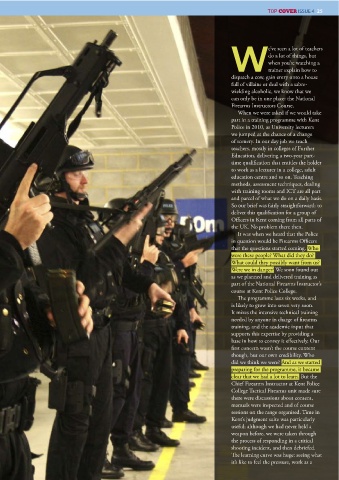
                                                                                  Were we in danger? We soon found out
                                                                                  as we planned and delivered training as
                                                                                  part of the National Firearms Instructor’s
                                                                                  course at Kent Police College.
                                                                                     T e programme lasts six weeks, and
                                                                                  is likely to grow into seven very soon.
                                                                                  It mixes the intensive technical training
                                                                                  needed by anyone in charge of firearms
                                                                                  training, and the academic input that
                                                                                  supports this expertise by providing a
                                                                                  base in how to convey it effectively. Our
                                                                                  first concern wasn’t the course content
                                                                                  though, but our own credibility. Who
                                                                                  did we think we were? And as we started
                                                                                  preparing for the programme, it became
                                                                                  clear that we had a lot to learn. But the
                                                                                  Chief Firearms Instructor at Kent Police
                                                                                  College Tactical Firearms unit made sure
                                                                                  there were discussions about content,
                                                                                  manuals were inspected and of course
                                                                                  sessions on the range organised. Time in
                                                                                  Kent’s judgment suite was particularly
                                                                                  useful; although we had never held a
                                                                                  weapon before, we were taken through
                                                                                  the process of responding in a critical
                                                                                  shooting incident, and then debriefed.
                                                                                  T e learning curve was huge: seeing what
                                                                                  it’s like to feel the pressure, work as a

