


Page 14 - index
P. 14
TOP COVER 524+0)

        5%+'0%' 10 6*' 564''6
       JUMPING THE GUN


                                                               94+66'0 $; ' $.1%-5+&)'


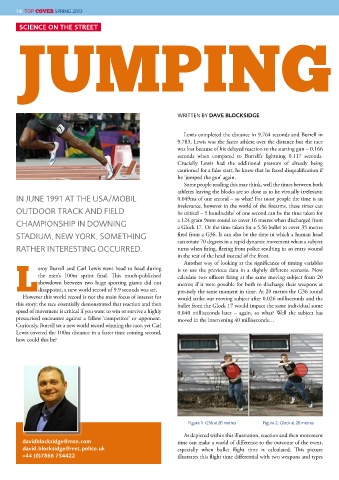
                                                                  Lewis completed the distance in 9.764 seconds and Burrell in
                                                               9.783, Lewis was the faster athlete over the distance but the race
                                                               was lost because of his delayed reaction to the starting gun – 0.166
                                                               seconds  when  compared  to  Burrell’s  lightning  0.117  seconds.
                                                               Crucially  Lewis  had  the  additional  pressure  of  already  being
                                                               cautioned for a false start, he knew that he faced disqualification if
                                                               he ‘jumped the gun’ again.
                                                                  Some people reading this may think, well the times between both
                                                               athletes leaving the blocks are so close as to be virtually irrelevant:
       +0 ,70'      #6 6*' 75# /1$+.                           0.049ms of one second – so what! For most people the time is an
                                                               irrelevance, however in the world of the firearms, these times can
       176&114 64#%- #0& (+'.&                                 be critical – 5 hundredths’ of one second can be the time taken for

       %*#/2+105*+2 +0 &190+0)                                 a 124 grain 9mm round to cover 16 metres when discharged from
                                                               a Glock 17. Or the time taken for a 5.56 bullet to cover 35 metres
       56#&+7/  0'9 ;14-  51/'6*+0)                            fired from a G36. It can also be the time in which a human head
                                                               can rotate 70 degrees in a rapid dynamic movement when a subject
       4#6*'4 +06'4'56+0) 1%%744'&                             turns when firing, fleeing from police resulting in an entry wound
                                                               in the rear of the head instead of the front.
                                                                  Another way of looking at the significance of timing variables
              eroy Burrell and Carl Lewis went head to head during   is to use the previous data in a slightly different scenario. Now
              the  men’s  100m  sprint  final.  T is  much-publicised   calculate two officers firing at the same moving subject from 20
              showdown  between  two  huge  sporting  giants  did  not   metres; if it were possible for both to discharge their weapons at
       Ldisappoint, a new world record of 9.9 seconds was set.  precisely the same moment in time. At 20 metres the G36 round
         However this world record is not the main focus of interest for   would strike our moving subject after 0.026 milliseconds and the
       this story; the race essentially demonstrated that reaction and then   bullet from the Glock 17 would impact the same individual some
       speed of movement is critical if you want to win or survive a highly   0.040  milliseconds  later  –  again,  so  what? Well  the  subject  has
       pressurised encounter against a fellow ‘competitor’ or opponent.   moved in the intervening 40 milliseconds…
       Curiously, Burrell set a new world record winning the race, yet Carl
       Lewis covered the 100m distance in a faster time coming second,
       how could this be?


                                                                   (KIWTG    )   CV    OGVTGU  (KIWTG    )NQEM CV    OGVTGU

                                                                  As depicted within this illustration, reaction and then movement
         FCXKFDNQEMUKFIG"OUP EQO                               time can make a world of difference to the outcome of the event,
         FCXKF DNQEMUKFIG"OGV RQNKEG WM                        especially  when  bullet  flight  time  is  calculated.  T is  picture
                                                               illustrates this flight time differential with two weapons and types

