


Page 9 - Top Cover Issue 7
P. 9
8  TOP COVER ISSUE 7                                                                        TOP COVER ISSUE 7  9

 KIND AND WICKED                                              full of gaps and misperception and it is these crucial elements
                                                                                  SCIENCE ON THE STREET


                                                              that can never be captured by camera. Decision choices are
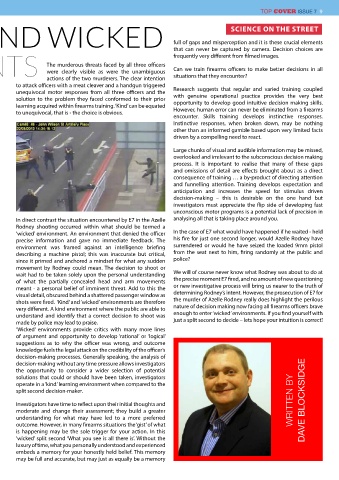
 ENVIRONMENTS    The murderous threats faced by all three officers   Can we train firearms officers to make better decisions in all
                                                              frequently very different from filmed images.

                 were clearly visible as were the unambiguous
                 actions of the two murderers. The clear intention   situations that they encounter?
 The dilemma that firearms officers have is that training may   to attack officers with a meat cleaver and a handgun triggered   Research suggests that regular and varied training coupled
 elevate their skills set to a level whereby fast decisions become   unequivocal motor responses from all three officers and the   with genuine operational practice provides the very best
 based upon subconscious neural probability. Personal survival   solution to the problem they faced conformed to their prior   opportunity to develop good intuitive decision making skills.
 will always win this neural competition for any cognitive   learning acquired within firearms training. ‘Kind’ can be equated   However, human error can never be eliminated from a firearms
 Rapid Decision Making  information exchange. This notion is extremely uncomfortable   to unequivocal, that is - the choice is obvious.  encounter. Skills training develops instinctive responses.
 to legislators and policy makers who genuinely believe that
 that all decisions are arrived at through rational and timely   Instinctive responses, when broken down, may be nothing
 Jumping to conclusions based upon limited information may just   processing. ‘Shooting while assessing’ sounds very precise and   other than an informed gamble based upon very limited facts
 save your life in certain circumstances, especially where there   laudable within policy documents, however it is not always   driven by a compelling need to react.
 is little or no time to think. Each of us has the ability to make   possible to match the dynamics of decision making with the
 instantaneous decisions with little or no time to rationally choose.   niceties of legalese.    Large chunks of visual and audible information may be missed,
 The more familiar you become working in high-risk environments,   overlooked and irrelevant to the subconscious decision making
 the more you rely upon previous experiences which are often   Skills training empowers the firearms officer with a high degree   process. It is important to realise that many of these gaps
 decisions  initiated subconsciously. Firearms training  sensitises   of confidence in their own ability to make good decisions   and omissions of detail are effects brought about as a direct
 officers to rapidly identify visual cues, and these become the   and this personal confidence increases with each and every   consequence of training … a by-product of directing attention
 precursors  enabling  the  swift  identification  for  threatening   successful ‘live’ operation when judgements turned out to be   and funnelling attention.  Training develops expectation and
 movements.  Training and operational experience reinforces the   correct. Confidence develops when the nature of the incident   anticipation and increases the speed for stimulus driven
 firearms officers’ ability to generate fast assessments skills, and   has a degree of predictability and the decision maker can match   decision-making – this is desirable on the one hand but
 the ability to initiate subconscious motor responses prior to any   the visual information to previous experiences. However, expert   investigators must appreciate the flip side of developing fast
 comprehensive understanding.    decision-making is not necessarily the exact science that some   unconscious motor programs is a potential lack of precision in
 people assume.  In direct contrast the situation encountered by E7 in the Azelle   analysing all that is taking place around you.
 Rapid decision-making or a  ‘gut feeling’ based upon limited   Rodney  shooting  occurred  within  what  should  be  termed  a
 information may instantaneously fill us all with a strong and   Training can have a very biasing effect and confidence is not   ‘wicked’ environment. An environment that denied the officer   In the case of E7 what would have happened if he waited - held
 compelling feeling to act, however, although decisions made   necessarily an accurate guide to making the correct choice   precise information and gave no immediate feedback.  The   his fire for just one second longer, would Azelle Rodney have
 under threat may feel ‘strong’, they do run the risk of being just   or judging a situation correctly. An interesting feature of   environment was framed against an intelligence briefing   surrendered or would he have seized the loaded 9mm pistol
 as equally ‘wrong’. It should be emphasised that this ‘strong’ but   unconscious (fast) decision-making is that people’s actions   describing a machine pistol; this was inaccurate but critical,   from the seat next to him, firing randomly at the public and
 ‘wrong’ aspect to skills training and decision making has no simple   frequently precede their understanding of why they have just   since it primed and anchored a mindset for what any sudden   police?
 antidote without the luxury of time and distance from any threat.   acted in a particular way. In other words, they use the outcome   movement by Rodney could mean. The decision to shoot or
 Even then, all of us have the ability to disregard information if   of the event to make sense – at a conscious level – of what they   wait had to be taken solely upon the personal understanding   We will of course never know what Rodney was about to do at
 it does not match the preferred solution identified by our brain.   have just done – at a subconscious level. In the face of ambiguity   of what the partially concealed head and arm movements   the precise moment E7 fired, and no amount of new questioning
                                                              or new investigative process will bring us nearer to the truth of
 the human brain rapidly favours one interpretation and is then   meant - a personal belief of imminent threat. Add to this the
 Strong but wrong decisions are made by all of us in our daily   loathe to part with it.  visual detail, obscured behind a shattered passenger window as   determining Rodney’s intent. However, the prosecution of E7 for
 lives, yet little attention is paid to decision making unless there   shots were fired.  ‘Kind’ and ‘wicked’ environments are therefore   the murder of Azelle Rodney really does highlight the perilous
 is a negative outcome. Psychological theory suggests that within   Psychological research suggests that we should think specifically   very different. A kind environment where the public are able to   nature of decision making now facing all firearms officers brave
 the brain there is a chain of operations that lead from visual   about two distinct types of circumstances where decisions must   understand and identify that a correct decision to shoot was   enough to enter ‘wicked’ environments. If you find yourself with
 perception to action commands; a common code develops   be made; these are often referred to as ‘kind’ environments and   made by police may lead to praise.  just a split second to decide – lets hope your intuition is correct!
 for what visual information means to the individual, and this   ‘wicked’ environments. Operational decisions are made within   ‘Wicked’ environments provide critics with many more lines
 becomes interpreted and matched to the individual’s knowledge.   both types of situations and good decisions are more likely to   of argument and opportunity to develop ‘rational’ or ‘logical’
 This is why individual interpretation is so important when giving   be made in ‘kind’ situations and error is more likely to appear   suggestions as to why the officer was wrong, and outcome
 evidence justifying what you have done and underpins the   within in ‘wicked’ environments.  knowledge fuels the legal attack on the credibility of the officer’s
 notion for an ‘honestly held belief’.   decision-making processes. Generally speaking, the analysis of
 In  ‘kind’ environments, people receive accurate and timely   decision-making without any time pressure allows investigators
 Neuroscience informs us that rapid decision-making occurs with   feedback that allows them to consciously assess and deliberate;   the opportunity to consider a wider selection of potential
 an incredibly fast ‘feed forward sweep’ of visual information, and   they may then shape and alter their responses as appropriate.   solutions that could or should have been taken, investigators
 this occurs before any rational process of problem solving can   However, in  ‘wicked’ environments, feedback is frequently   operate in a ‘kind’ learning environment when compared to the
 be applied.  This means that visual stimuli are subconsciously   lacking or misleading and people must commit to a rapid choice   split second decision-maker.
 matched against familiar outcomes lodged within our long-term   built upon experience and confidence alone. Errors become far
 memory, subconsciously, within hundredths of 1second.  more likely when firearms officers operate in ‘wicked’ situations   Investigators have time to reflect upon their initial thoughts and   WRITTEN BY  DAVE BLOCKSIDGE
 where intelligence could be wrong and misinterpreted –   moderate and change their assessment; they build a greater
 Based upon limited information the brain will try and resolve the   however, the proximity of threat and time pressure demands   understanding for what may have led to a more preferred
 threatening dilemma based upon ‘what usually’ happens – and   action from the officer in order to save life and they are forced   outcome. However, in many firearms situations the ‘gist’ of what
 this can occur without any recurrent processing by the brain in   into making a choice.  is happening may be the sole trigger for your action. In this
 the  ‘solutions’ storage area. Recurrent processing means that   ‘wicked’ split second ‘What you see is all there is’. Without the
 neurons within the brain ‘share’ information and an analysis is   The murder of Gunner Lee Rigby at Woolwich placed 3 Met   luxury of time, what you personally understood and experienced
 made between brain cells, however, under extreme time pressure   Police ARV officers into what psychology would define a ‘kind’   embeds a memory for your honestly held belief. This memory
 this comparison may not be made and the decision you make   decision making environment… albeit both a terrifying and   may be full and accurate, but may just as equally be a memory
 becomes the first solution identified.  deadly one!

